|
||||||||
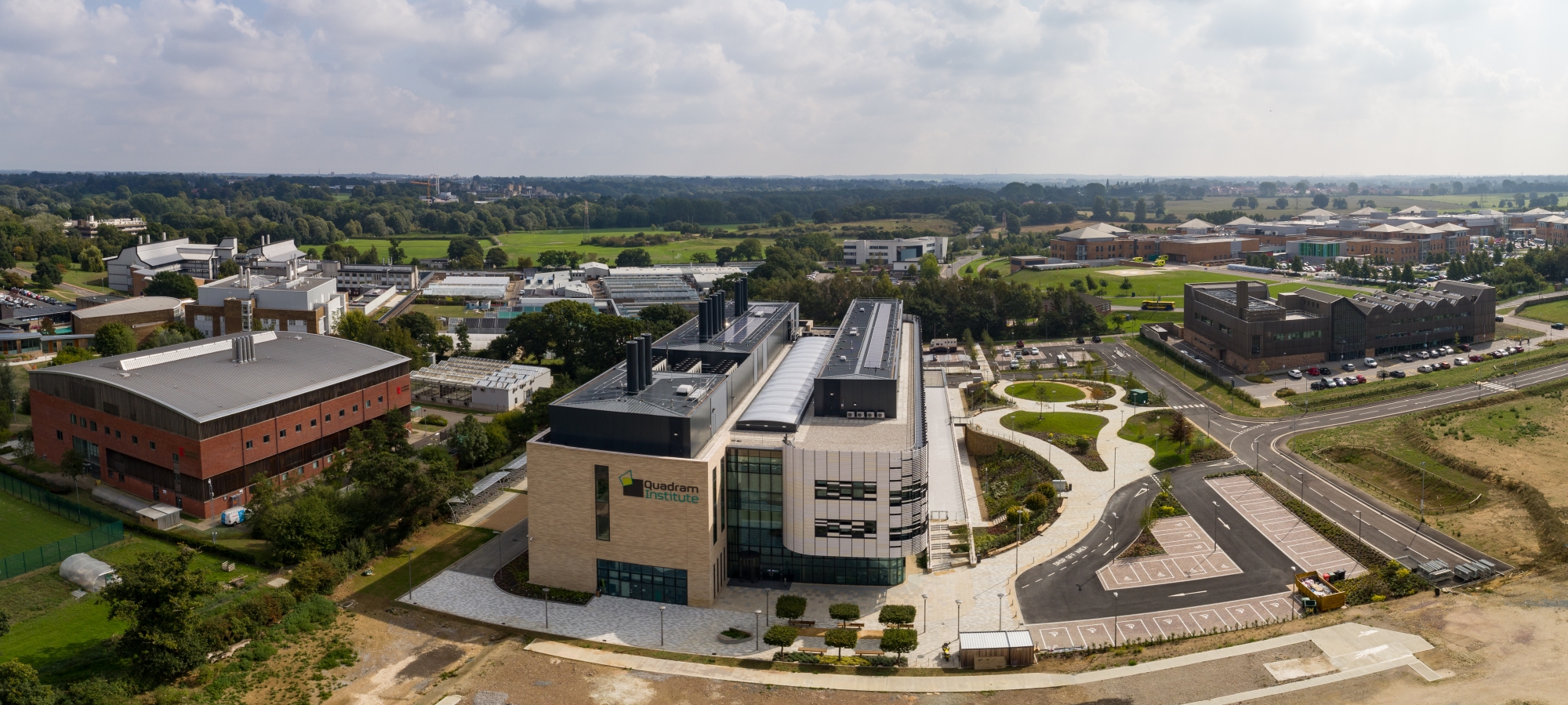
Norfolk is home to a cluster of internationally-renowned research organisations. They are working together to tackle the major challenges facing all of us in the 21st Century – the sustainability of our environment; our food supplies and healthy ageing. There are over 2500 scientists working to find realistic and practical solutions; who then have the infrastructure and support to translate these discoveries into commercially successful business.
http://www.worldclassnorfolk.com/work/future-science
Norwich is ranked 4th in the UK for the number of “most
highly cited scientists” after London, Cambridge and
Oxford and ahead of cities such as Bristol, Manchester, Edinburgh,
Nottingham and York – evidence of our outstanding international
reputation
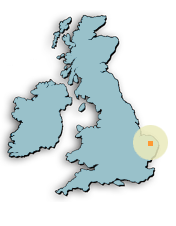
Co-located adjacent to the University of East Anglia on the Norwich Research Park in Eastern England
The Minister for Universities and Science, the Right Hon. David Willetts MP, visited Norwich Research Park (NRP) in March, following the Budget announcement by Government and the Biotechnology & Biological Sciences Research Council which will see £26M invested to deliver innovation from bioscience at Norwich Research Park.
The NRP Innovation Centre at the Norwich Research Park (NRP) in Norfolk (UK) opened for business today (4th August 2010) following a £5m investment in brand new laboratory and office facilities for expanding science and innovation businesses. The NRP Innovation Centre is the first phase of the Norwich Research Park’s ambitious plans to create 5000 jobs in the next 10 years. Over 30 office and laboratory units have been constructed and fitted out in a totally refurbished and customised 4,215 sq m (43,000 sq ft) three-storey building, located on the NRP. The facilities have been designed to attract businesses working in science and science-related disciplines looking to grow in a world class science cluster. (more...)
A £5M development at the Norwich Research Park (NRP), funded by a partnership including the Biotechnology and Biological Sciences Research Council (BBSRC) will provide facilities for start-up and growing businesses that will turn world-class science into products and technologies. This new development will bring new innovation and a boost to local and national economies. Over 30 office and laboratory units will be created in a totally refurbished and customised building housing up to 300 new staff. The main contractors have been appointed to carry out the work and the new facilities will be fully operational as early as July 2010. (more...)
Investment in bioscience skills and training to help meet economic and social challenges for the future
The John Innes Centre is leading a group of research institutes on the Norwich Research Park (NRP) that are to receive almost £4million of new funding from the Biotechnology and Biological Sciences Research Council (BBSRC) to support the training of the next generation of scientists. The investment will fund 39 PhD students through a Doctoral [...]
Science & Art in Box
GCSE art students from Hethersett High School and scientists from the John Innes Centre were asked to consider the question “How will GM (Genetic Modification) influence the future of our planet?” Their visual responses are contained in a series of boxes that will be on display at JIC following a successful viewing at the Hethersett [...]
Flowers in February
This winter has been so mild we wouldn’t be surprised if plants were blooming in February! But what happens in a normal season? Just how do plants control when and how they flower? Find out in an evening devoted to one of nature’s most magnificent events – flowering – and how research at the John [...]
Natural Factories
Plants and microbes produce a wide spectrum of natural products, which give them their huge range of colours, flavours and scents. These chemicals are used to repel pests, diseases or competitors or to attract pollinators, but for humans they represent a potential source of new medicines, flavourings, antimicrobials or other useful compounds. A major area [...]
Pupils ‘tripling’ their chances of success in science
The Teacher Scientist Network (TSN), which is based at the John Innes Centre, will host an exciting science fair for almost 400 high school pupils from across Eastern Norfolk with leading research scientists tempting them to aim for careers in science and technology. The aim of the day is to encourage Year 8 & 9 [...]
Startup Masterclass
Dull but necessary! How to avoid awful muddles and other legal nasties Setting up a new business is actually an easy thing to do. But very often, certain decisions taken too lightly can then come back to bite. Especially if you have other co-founders, own IP or want to distribute equity to collaborators. Come [...]
Feeling the heat
Some summers can be too hot to handle. In 2003, 35,000 people died in Europe as a result of a record heat wave. Too much sun, too much heat and not enough water makes us sick. The same goes for plants. Including ones that feed us and our livestock. Leaves grow more slowly, less water [...]
Scientists and teachers unite to bring cutting-edge science to Lynn Grove High School
Lynn Grove High School in Gorleston, Norfolk, has been chosen by The Royal Society, the UK’s national academy of science, to receive a Partnership Grant that will enable local scientists to work with teachers from the school to implement an innovative science project. The project, called “E.coli on the move,” aims to investigate the distribution [...]
Investment in bioscience skills and training to help meet economic and social challenges for the future
IFR is part of a consortium of research institutes on the Norwich Research Park that are to receive almost £4million of new funding from BBSRC to support the training of the next generation of scientists. The investment will fund 39 PhD students through a Doctoral Training Partnership award.
Next generation sequencing surveys Salmonella
Salmonella bacteria cause over a billion cases of illness worldwide each year, and over 500,000 deaths. To help efforts to reduce this, Dr Arthur Thompson and colleagues at IFR have produced the first extensive and accurate map that shows where in the Salmonella genome genes are switched on and read from.
Microbiology to play crucial role in ensuring food security
Professor Mike Peck of the Institute of Food Research has joined other experts from the Society for General Microbiology in launching a position statement on food security and safety. This sets out the key role that microbiology will play in ensuring that the 7 billion people in the world have access to safe and nutritious food.
Plant Food Supplement science and regulation meet up in Brussels
Partners on an EU project, including IFR, met with food regulators from many countries recently to discuss priorities in the science of plant food supplements.
Night at the museum for IFR scientists
Combase, the predictive microbiology database co-ordinated by IFR, was recently showcased to a public audience at the Natural History Museum in London, at an event designed to let people get hands-on with cutting edge science and meet the people behind it.
European Food Alliance: Nine successful European agrifood clusters join forces
The Institute of Food Research is part of a group of European agrifood organisations that have set up the European Food Alliance. to aid networkingwith the agrifood industry.
Researchers to identify the secrets of Salmonella’s survival
IFR researchers are to investigate how Salmonella survives during its lifecycle within our bodies, as a way of finding chinks in its armour that can be exploited to develop new therapies.
British research leads to UK launch of Beneforté broccoli
A new variety of broccoli with higher levels of a key phytonutrient is now available in UK shops thanks to experts working on both the biology of plants and the link between human nutrition and health. The new broccoli, which will be known as Beneforté, was developed from publicly-funded research at the Institute of Food Research and the John Innes Centre.
Investment in bioscience skills and training to help meet economic and social challenges for the future
The Genome Analysis Centre is part of a consortium of research institutes on the Norwich Research Park (NRP) that are to receive almost £4million of funding from the Biotechnology and Biological Sciences Research Council (BBSRC) to support the training...
Hidden genetic variants revealed by new computational technique
In a paper published today in Nature Genetics, Zamin Iqbal from the Wellcome Trust Centre for Human Genetics in Oxford and Mario Caccamo from The Genome Analysis Centre in Norwich, along with colleagues, report the development of a novel...
Data-Intensive Computing in Biology Workshop
Monday 6 February – Wednesday 8 February 2012
Merrison Lecture Theatre, STFC Daresbury Laboratory, Daresbury Science and Innovation Campus, Warrington, WA4 4AD
Registration is FREE for this event
A major theme of biology today...
Investment in cereal genomics to breed better varieties
Two new research projects announced today (21 December) aim to make an important contribution to global efforts to breed improved cereal crops.
The projects hope to shed further light on the genomes of wheat and barley, the two...
Vicky Ford MEP for the East of England visits Norwich Research Park
Vicky Ford, Member of the European Parliament for the East of England, visited Norwich Research Park on Friday 18 th November to see for herself the latest developments in science and innovation coming from the institutes and companies...
Genome sequence sheds new light on how plants evolved nitrogen-fixing symbioses
The results of the analysis of a high quality genome sequence of Medicago truncatula was published today in Nature. This will provide a valuable resource for future legume biological research.
...
Norwich Research Park Attracts Angels
Now is an exciting time for angel investment: there are many interesting opportunities emerging from the research community and tax incentives from Government for those that support early-stage businesses. The Norwich Research Park is hosting an angel event on...
Applications open for the Undergraduate Summer Programme
Applications are now open for the International Undergraduate Summer Research Training Programme. The 8 week programme is co-hosted by The John Innes Centre , The Sainsbury Laboratory and The Genome Analysis Centre and provides...
Norwich gene hunters tackle crop diseases
Norwich scientists are on the trail of some of the most economically damaging organisms that infect crops worldwide. Their latest targets are the parasitic water fungus that causes powdery mildew and the water molds that cause late blight in potatoes and tomatoes and downy mildew in cruciferous vegetables and other crops.
GM trial to reduce agrochemicals
A field trial of GM potatoes is being planted this week to test whether genes from wild relatives can successfully protect commercial potato varieties from late blight, the disease that caused the Irish potato famine, without the need to spray fungicides.
Royal Society global food security report published
The Sainsbury Laboratory welcomes a Royal Society report calling for an investment of £2 billion into a research programme on global food security. The report published today (21 October 2009) says that the UK should lead international research efforts if we are to achieve the massive increase in food crop production that will be required by 2050 to meet global food demands without damaging the environment.
TSL scientists helped crack the code that bacteria use to manipulate agricultural crops
Sebastian Schornack, currently working with Sophien Kamoun at TSL, co-disovered the code which explains how bacterial effectors bind to specific host plant DNA sequences, manipulating host gene expression and leading to disease. This work is now published in Science.